What are sheet metal tolerances in sheet metal processing and what are they used for?
Sheet metal can be processed in a variety of ways, such as punching, laser-cutting, and bending. In sheet metal part production, the permissible tolerances must always be taken into account, as is the case when designing other components. It is almost impossible to manufacture workpieces to 100% scale. The standard-compliant dimensioning of sheet metal parts therefore plays an important role. Without further accuracy information, they are usually manufactured according to general-purpose tolerances. If details or a complete component are required at higher accuracy, the permissible deviation for these must be defined by specifying the tolerance in advance.
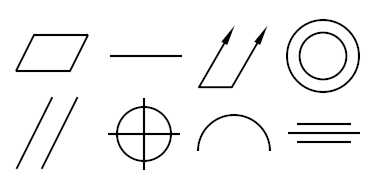
See this blog for an overview of ISO 1101 symbols used in engineering drawings.
The higher the degree of accuracy, the more expensive the production will be. Tolerances are used to ensure that such deviations are taken into account to a defined extent and that the finished products can be installed with an accurate fit. Tolerances must always be determined while keeping an eye on accuracy and feasibility, along with production costs. A upper and lower limit are defined. The tolerance field lies between these. The tighter the tolerance, the more accurate the workpiece is. Sheet metal processing relies on general-purpose tolerances for the following sheet metal features:
- Angle dimensions: Tolerances for angles, e.g. for bends.
- Shape: Shape tolerances such as flatness or roundness to ensure that the intended shape is maintained.
- Position: Ensure the exact position, e.g. symmetry when punching a hole into the sheet metal. This ensures that the sheet metal can be accurately assembled with other components.
- Bores: Tolerances exist, for example, for the dimensions of the bore, the distance from bore to bore, or the edge distance of the bore in steel. They are important to avoid cracking and deformation. In addition, a correctly maintained edge distance contributes to the strength and stability of the sheet metal.
- Thickness: Material thickness tolerances