Shafts as mechanical components
What are rotating shafts?
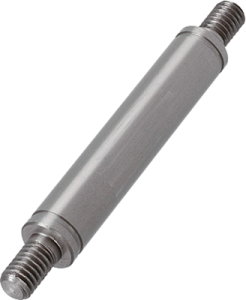
Shafts are typically used in applications where rotational motion and torque are transmitted. Typical applications include motors, machine tools, and fans.
A rotating shaft, also known as a motor shaft or torsion shaft, rotates and is held in place by shaft bearings. It transmits torque generated by, for example, gears or a coupling to another component such as a pulley. The rotating shaft (motor shaft) is primarily subjected to torsional stress. In most cases, in addition to the torque, additional transverse forces and thus bending stress on the shaft also occur. Dimensioning is therefore based on the torsional stress, although any bending stress that may occur must also be taken into account.
Rotary shafts are usually made of metal, but can also be made of plastic for lower loads. When designing a rotary shaft, strength, stiffness, vibration behavior, and expected wear play a significant role.
Rotary shafts are available in various designs and dimensions. When designing the system, attention should be paid not only to the shaft and its required minimum cross-section but also to the appropriately sized and correctly aligned shaft bearings. Click here to learn more about optimal bearings for rotary and torsional shafts.