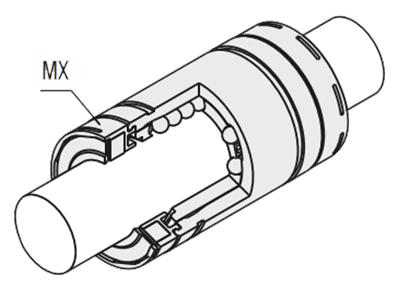
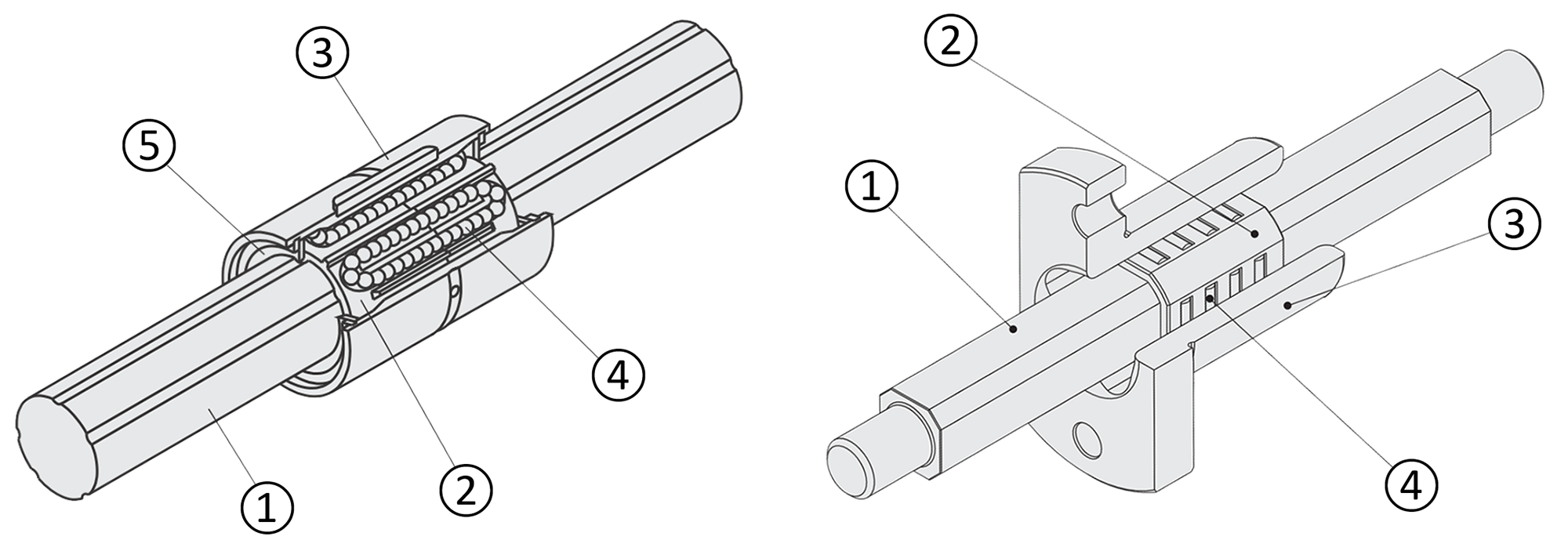
Linear ball bearings are used in conjunction with linear axes. The linear movement mechanism usually uses steel roller balls for unlimited linear motion. The steel balls run continuously within the specified track of the ball cage while rolling on the surface of the linear shaft. Linear ball bearings perform linear motion with lower friction and high accuracy compared to plain bearings. Linear ball bearings are used in many applications, such as material handling equipment and semiconductor manufacturing lines.
In addition to linear ball bearings, there are also other forms of rolling bearings that allow linear movement. This includes, for example, ball cage guides or needle guides. For ball cage guides, the balls are located in a cage that rolls and glides on the inner and outer surfaces. However, the cage also minimizes the path, which is why this form of rolling bearings is only suited for short linear motions. Needle guides require a guide shaft with flat surfaces for rolling the rolling elements. They are designed similar to the ball cage guide, but are able to absorb higher forces due to the needle-shaped rolling elements. The needle shape also prevents twisting. However, needle guides are only suited for short linear motions. Neither shape has a recirculation mechanism.
Linear ball bearings generally do not have an anti-rotation feature. Torque-transferring alternatives are ball grooved shafts, also called torque shafts, and needle guides. Since splined shafts can also be used as guide shafts, but are not roller-based shafts, these are not considered here.